Battle of Gettysburg
Young Captain Jack · The Son of a SoldierThe Battle of Gettysburg is remembered in the novel chiefly through its aftermath: Colonel Martin Ruthven is killed there, leaving a widow and two children, while the war’s continuing violence places their South Carolina home under threat. The battle therefore functions less as a separate battlefield episode than as the absent event around which family bereavement, local defense, and Jack Ruthven’s military formation are organized.
The Battle as Family Catastrophe
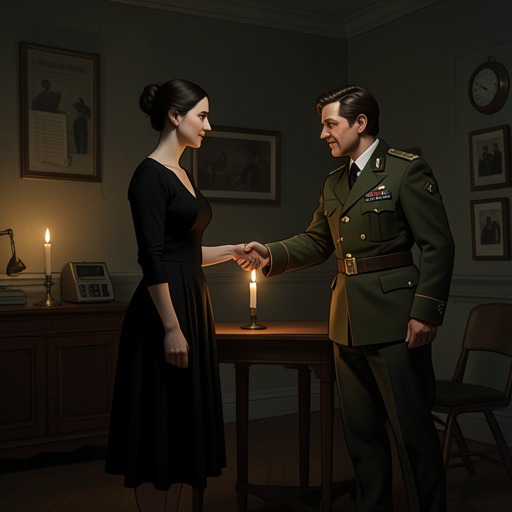
The clearest fact attached to the battle is Colonel Martin Ruthven’s death. Mrs. Ruthven becomes a widow after losing her husband at Gettysburg, and the sudden loss strikes both the household and the children with exceptional force. Mrs. Ruthven falls seriously ill for a long period and remains weak and pale even after she is able to move about again. Her surviving consolation is her children, especially the close bond between Jack Ruthven and Marion Ruthven, who are described as nearly inseparable.
This private grief gives the battle a domestic scale. Gettysburg is not presented only as a military engagement involving armies; it is also the cause of an altered household, a mother’s prolonged sickness, and children compelled to live under the shadow of a father’s death. The event remains geographically distant from the Ruthven plantation, yet its effects are immediate and continuing: Colonel Ruthven’s absence changes the emotional structure of the family and leaves Jack and Marion more firmly attached to one another and to their mother.
War Reaches Oldville
The battle’s consequences belong to a wider wartime crisis. In Oldville, the district surrounding the Ruthven plantation, the inhabitants endure a difficult week as the Union Army presses the Confederate States Army backward. Confederate forces camp less than four miles from Jack Ruthven’s home, and cannon fire can be heard distinctly for two days. The memory of Colonel Ruthven’s death consequently exists alongside the prospect of renewed invasion, making the family’s mourning inseparable from the danger still advancing across the region.
The threat transforms the plantation from a private residence into a defended community space. Jack Ruthven organizes a company of twenty-three boys with Darcy Gilbert and serves as its captain. He possesses an old sword and a pistol, while the other boys carry pistols or guns. His response to the war is practical rather than merely emotional: the boy who has already lost a father becomes responsible for protecting his mother, Marion Ruthven, and the homestead.
The Ethical Shadow of the Battle
The novel contrasts military conduct with predatory violence in the wartime landscape that follows Gettysburg. A cavalry force passes the Ruthven homestead without disturbing it, but a company of guerrillas follows behind, characterized as men who fight chiefly to loot afterward. Jack Ruthven places his boys across the lawn and insists that the property must be respected. He adds that the house is a hospital containing six wounded Confederates under a surgeon’s care.
Jack’s appeal invokes two boundaries that the guerrillas threaten to erase: the boundary between private property and military seizure, and the boundary between a hospital and an ordinary target. A Confederate colonel later assures him that an officer who is a gentleman respects private property and that the wounded give the defenders nothing to fear so long as they act without treachery. The scene makes Gettysburg part of a larger moral comparison. The formal soldier’s restraint stands against the guerrillas’ appetite for plunder, while Jack’s defense of the homestead gives a young civilian a conduct-based claim to authority.
From Wartime Loss to Jack’s Military Identity
Gettysburg also foreshadows the military identity Jack Ruthven eventually acquires. He is introduced as manly, self-reliant, and difficult to intimidate, qualities that become visible in his organization of the Home Guard and in his insistence that armed men respect the hospital and the household. His courage is tested further when Dr. Mackey seizes him and orders soldiers to conduct him to camp, and when Jack is held prisoner in a mountain cabin with his hands bound behind him to a heavy wooden stake. Later, he and his companions spend two days in a guerrilla cave, where they receive barely enough food to avoid starvation and endure brutal treatment, particularly from Pete Gendron.
These episodes convert inherited loss into lived trial. Jack is not simply the son of a dead soldier in the emotional sense created by Colonel Ruthven’s death; he is repeatedly placed in situations requiring endurance, judgment, and resistance. When he learns that he is not Dr. Mackey’s son but Colonel Stanton’s son, the revelation changes the meaning of his uncertain parentage, yet it does not erase the formative influence of the Ruthven household or the wartime example associated with his lost foster father.
Long-Term Consequence
The novel’s conclusion binds the memory of Gettysburg to Jack Ruthven’s completed career. Years later, he enters West Point Military Academy, graduates with high honors, and goes West as an officer at a well-known fort. His daring and honorable service quickly raise him to the rank of colonel, a position he fills with the bravery and loyalty already evident in his youth.
Thus the Battle of Gettysburg has a double narrative effect. It first removes Colonel Martin Ruthven and leaves a family wounded by grief; later, through the war’s continuing dangers and Jack’s response to them, it becomes part of the background against which Jack develops into a soldier. The battle is recalled as loss, but its lasting dramatic consequence is transformation: a household survives its fallen patriarch, and the boy shaped by that absence eventually assumes the military role that the novel associates with courage, loyalty, and honorable service.